
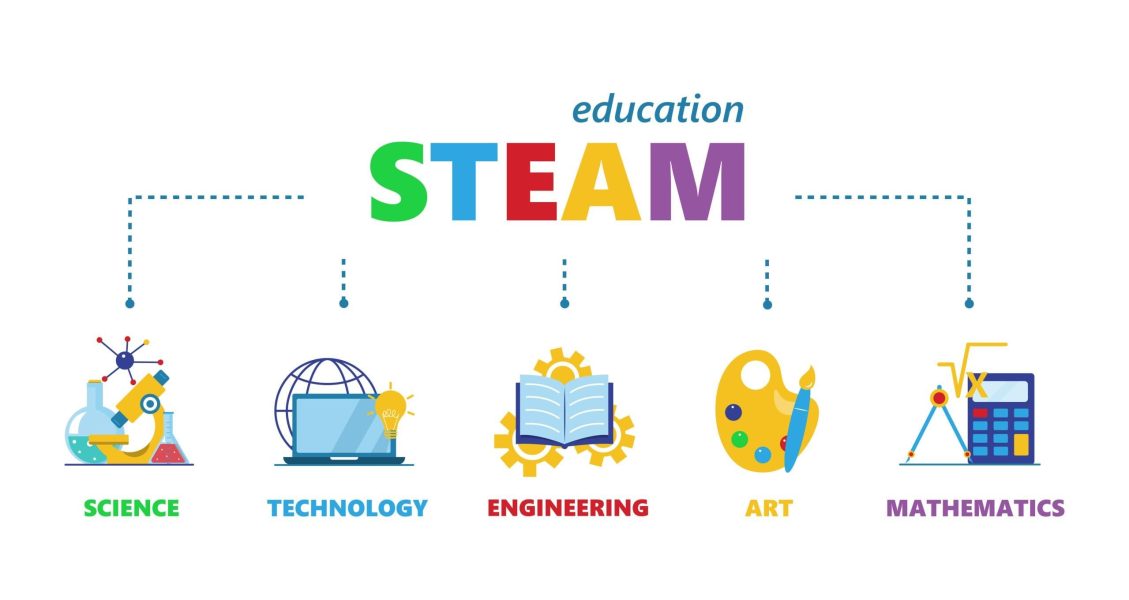
You may have heard the two educational terms STEM and STEAM interchangeably but did you know they have different outcomes and academic focuses?
All parents likely want to give their children the opportunity to explore, develop new skills, and thrive in the future. STEAM builds upon STEM by incorporating the Arts, merging creativity with technical expertise. While not a completely new concept, it represents an exciting and transformative evolution.
This article talks about how that extra ‘A” in STEAM builds on STEM and is a mere extension of STEM and not a new concept entirely.
What Is STEM?
STEM is an educational approach that blends science, technology, engineering, and mathematics. Together these learnings equip young learners with skills that would help them in the future.
STEM Education aims to equip children with the skills needed to tackle various challenges in adult life. By learning to navigate these challenges, they can confidently pursue and succeed in the career of their choice.
Importance of STEM Education
STEM plays a significant role in society since there is a huge demand for highly skilled workers in the field of science, technology, engineering and math.
When schools focus on STEM, they excite students to gain scientific knowledge and open doors to careers in fields like engineering, medicine, and more. With the right skills for the job market, employment rates improve for everyone!
STEM offers more than just pursuing such careers; it instills lifelong skills such as communication, collaboration, and critical thinking.
Benefits of STEM Education
Resilience
STEM education teaches kids how to adapt, recover, and thrive in the face of adversity and challenges. It’s not just about making them ready for a job but also teaches them to cope up with ups and downs. Coping up with challenging math problems through trial and error helps kids learn to deal with failure. These lessons build resilience in students which they carry on for life.
Innovation
STEM is all about thinking big and taking risks. A young child who has learned to solve problems creatively and come up with unique ideas might one day launch the next breakthrough tech company. It’s all about building the spark to be innovative from an early age.
Technology
In today’s world, being tech-savvy is necessary, and STEM gets kids comfortable with technology. Considering it as a useful tool, technology sets these young minds up for success in a job market where tech skills are in high demand.
Technology is everywhere today, from AI to green energy, and STEM is leading the way. It’s giving students the skills to think clearly and handle real-world challenges in creative ways.
STEM isn’t just about learning; it’s about getting ready for a future packed with exciting possibilities when children are exposed to STEM Education at an early age.
Enter the “A” in STEAM
STEAM improves on the solid foundation of STEM by adding the Arts, which include creative disciplines like visual arts, music, and design. STEAM isn’t just about science and math—it’s about weaving creativity into the mix. STEAM explores how we express and communicate ideas uniquely, from painting and photography to writing and even performing arts. It’s the perfect balance of technical skills and creative thinking.
The arts component is about replacing and enriching core technical subjects. The integration of arts into STEM, STEAM develops well-rounded learners who are tech-savvy, creative and adaptable. A combination that is highly valued in the modern workplace.
Why Does STEAM Education Matter?
STEAM expands this foundation by fostering creative thinking and innovation, skills increasingly sought after in industries where technical expertise must align with human needs, aesthetics, and experience.
By incorporating the Arts, STEAM prepares students for future careers that require interdisciplinary knowledge and adaptability. Here’s how STEAM education can shape their career prospects:
Design and Innovation Roles: Industries like product design, UX/UI design, and architecture blend technical knowledge with creativity. Professionals in these fields need to understand both how things work (STEM) and how to make them visually appealing and user-friendly (Arts).
Emerging Creative Tech Careers: The rise of fields like augmented reality (AR), virtual reality (VR), game design, and digital animation requires a seamless combination of STEM knowledge with artistic skills. STEAM education prepares students to create immersive experiences that are both technologically advanced and creatively engaging.
Entrepreneurship and Startups: Entrepreneurs need both technical skills to build solutions and creative thinking to innovate and differentiate their products or services. STEAM education nurtures this dual capability, helping future business leaders tackle problems in unique, impactful ways.
Interdisciplinary Professions: Careers like bioinformatics, medical illustration, or scientific communication require blending the precision of STEM with the expressive power of the Arts. These roles are crucial for making complex ideas accessible and impactful.
Jobs of the Future: As automation and AI continue to reshape the job market, creative and interdisciplinary problem-solving will become the most valuable skills. STEAM education equips students to think beyond standard solutions, making them indispensable in a world where creativity drives innovation.
Most importantly, STEAM shows us that creativity is the key to innovation. It’s what helps solve big problems and create the next big thing. Thinking creatively turns good ideas into amazing ones. STEAM gives kids the skills to understand the world and the imagination to change it.
Benefits of STEAM Education
Boost Creativity
Adding arts to STEM (turning it into STEAM) fuels creativity by encouraging kids to think beyond conventional boundaries. It teaches the young minds to look at several angles while problem solving and come up with innovative solutions. This includes designing a user-friendly app, creating an eco-friendly product, or composing a compelling presentation.
Enhance Communication
STEAM education emphasizes storytelling, design, and visual communication as powerful tools for sharing complex ideas. Kids learn how to present technical concepts relatable and engagingly through a dynamic infographic, well-scripted video, or collaborative presentation. These skills are invaluable in bridging the gap between technical knowledge and real-world application.
Promote Collaboration
Integrating artistic creativity into STEM disciplines, STEAM encourages teamwork. Students get to handle different projects based on talents like coding, writing, or designing.This collaborative environment is a reflection of real-world industries, a common ground where blending technical and creative skills leads to groundbreaking innovations. When students work as at team they learn to appreciate different perspectives and achieve shared goals.
Why STEAM Matters for Your Child
Incorporating the arts into education is not just about encouraging creativity but also about teaching kids how to think critically and approach challenges holistically. For example, a STEAM program might encourage children to design and build a bridge (engineering) that can hold weight (science and math) while also making it aesthetically pleasing (arts). Using this multidimensional approach can help students solve problems with technical expertise and creative insight.
Linking to Real-World Opportunities – The STEAM Holiday Program
At Piex, we understand the importance of equipping kids with skills that span STEM and STEAM. Our STEAM Holiday Program is designed to engage young minds in fun, hands-on projects. Our program helps students blend technical learning with artistic exploration. We teach skills that range from coding and robotics to painting and design, we cover it all. Plus, we focus on building key skills to prepare children for success in an ever-changing world.
How to Support Your Child’s STEAM Journey
Parents play a vital role in fostering a love for STEAM at home. Here are a few tips:
Encourage Curiosity – Let kids explore their interests, whether building a robot or drawing comic strips.
Provide Tools – Invest in STEAM kits, apps, and resources that make learning interactive.
Join Programs – Enroll your child in after-school or holiday programs like Piex’s STEAM Holiday Program.
Celebrate Creativity – Value the artistic side of your child’s achievements as much as their technical ones.
Closing Thoughts
STEAM is not a replacement for STEM; it’s an extension that combines technical precision with creativity to bring learning to life. As a parent when you consider the best educational opportunities for your child, remember that the arts aren’t just “extras”. They are essential tools for building innovation and empathy and encouraging problem-solving. Check out our STEAM Holiday Program today and spark passion for learning in your kids.