
Fundamental of Challenge-Based Learning
Challenge-based learning (CBL) started with the movement of “Apple Classrooms of Tomorrow—Today” which identifies the crucial design principles of the 21st century learning environment (Apple Inc., 2020). CBL builds on the theory of experiential learning founded by John Dewey, Kurt Lewin and Jean Piaget (Kolb, 1984).
How does CBL work?
CBL starts with a “big idea” which involves a broad issue affecting schools or communities. Throughout the challenge students have the opportunity to create a variety of products. These include, but are not limited to animation videos, games, journal articles, infographic posters, group or individual reflective videos and more (Apple Inc., 2020).
One of the important aspects of CBL is that students determine the direction of the research and solution. The challenge proposal where students state their big ideas, list out the guiding questions that help guide their search for solutions to their challenge, and why it’s important to them. Solving a problem that is meaningful and close to their hearts won’t only motivate students, but will also create meaningful learning for them (Apple Inc., 2020).
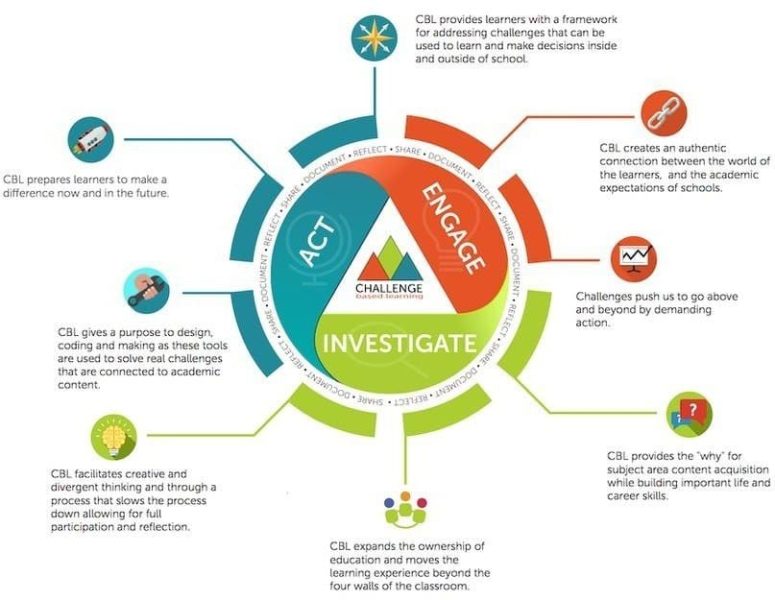
The structure of challenge-based learning:

Source: https://www.challengebasedlearning.org/framework/
What is the Role of Educators in CBL?
The teacher’s role in CBL is to be a project manager, coach or mentor. As such, tremendous preparation work is required from teachers themselves to successfully implement CBL in the classroom (Apple Inc., 2020).
The structure/phases of challenge-based learning:
Engage – Students use the ‘Essential Questioning process to guide them in identifying concrete and actionable challenge statements. The purpose of this phase is to have students connect and engage with the challenge, and feel excited about solving it.
Investigate – Students carry out content and concept-based research to find out as much information and evidence as possible. They then use this to create actionable and sustainable solutions for the challenge.
Act – Students develop and implement the evidence-based solutions with a genuine audience and then the final results are evaluated. Students not only master content successfully, but will make a difference more so in their communities.
Where was CBL first Implemented and What was the Result?
CBL research was first mainly carried out in the United States (Johnson and Adams, 2011). Another study was carried out at Ringwood North Primary School in Melbourne, Australia and the result was encouraging. It was found that students’ self-esteem and confidence increased and their overall teamwork skills also improved.
The most profound finding through this research revealed that CBL helped develop kids’ empathy. One of the students stated in his reflective video “I’m making a difference. I’m not just feeling sorry for people — I’m trying to help people, and it makes me feel like a better person.” (Mark CBL, 2016).
This CBL sustainability project was carried out with 220 Year 7 boys in 2013 which showed not only students benefiting from CBL, but teachers also gained professional learning through this experience (Corcoran & Jensen, 2013). This was especially so for those teachers who were at first, hesitant to use technology (Corcoran and Jensen, 2013).
Frequently Asked Questions
What are some practical instances of challenge-based learning in practice?
Challenge-based learning (CBL) can be seen in various settings. For example, students may work on solutions to local environmental issues, such as reducing plastic waste in their community.
How is challenge-based learning different from project-based learning?
While both approaches encourage active learning, challenge-based learning focuses on addressing real-world problems. It often involves collaboration between students and community members, whereas project-based learning may not always incorporate external stakeholders. CBL emphasises identifying a challenge and the solution’s impact, showcasing a more community-oriented approach.
What are the main principles that guide challenge-based learning?
Key principles of challenge-based learning include:
- Real-World Relevance: Addressing issues that matter in the community.
- Collaboration: Working together with peers and community members.
- Learner Agency: Empowering students to take charge of their learning.
- Reflective Practice: Encouraging students to reflect on their experiences and outcomes.
What steps are involved in implementing challenge-based learning (CBL)?
The CBL process typically includes:
- Identifying a Challenge: Students pinpoint a relevant issue to address.
- Research and Inquiry: Gathering information and exploring the challenge.
- Creating a Solution: Developing actionable plans to tackle the challenge.
- Taking Action: Implementing the solution within the community.
- Reflection and Feedback: Reviewing the outcomes and learning from the experience.
What kind of activities are commonly part of a challenge-based learning programme?
Activities in a CBL curriculum may vary but often include:
- Group Discussions: Collaborating with peers to brainstorm ideas.
- Field Research: Gathering data from the community or relevant stakeholders.
- Presentations: Sharing findings and solutions with a wider audience.
- Hands-On Projects: Engaging in activities that directly address the identified challenge.
How is teaching adapted to fit the challenge-based learning model?
In a CBL framework, educators modify their teaching methods to facilitate active student participation. This may involve:
- Shifting the Role of the Teacher: From knowledge provider to facilitator.
- Encouraging Exploration: Allowing students to pursue their interests within the challenge.
- Integrating Assessment: Using formative assessments to guide student learning throughout the process, rather than focusing solely on final outcomes.